
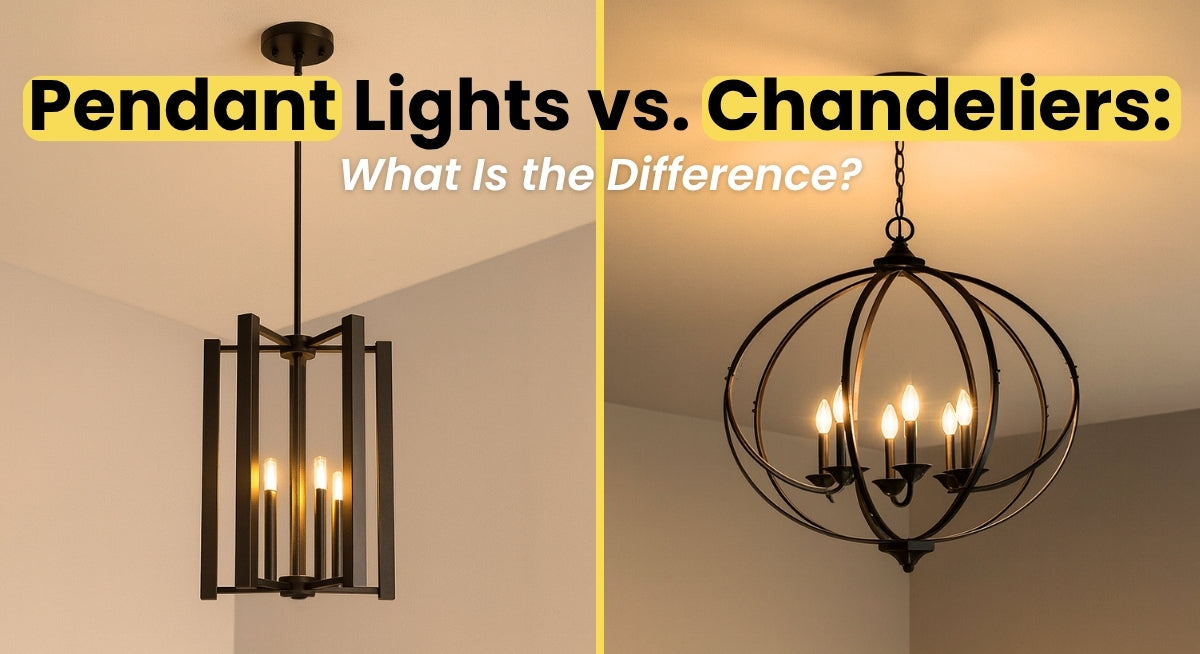
Pendant Lights vs. Chandeliers: What Is the Difference?
When choosing decorative lighting for your home, pendant lights and chandeliers are two of the most popular options. Both fixtures hang from the ceiling, provide functional light, and can become a major part of a room’s design. However, they differ in size, structure, light output, and where they work best.
Understanding the difference between pendant lights and chandeliers can help you select a fixture that fits your room, complements your décor, and provides the right amount of light.
What Is a Pendant Light?

A pendant light is a hanging light fixture that normally features one central light source suspended from the ceiling by a cord, chain, or metal rod.
Pendant lights are available in many shapes, sizes, finishes, and styles. Some have compact glass shades, while others feature oversized metal domes or decorative frames. Because they are usually smaller than chandeliers, pendant lights can be installed individually or grouped together.
Common places to use pendant lighting include:
-
Kitchen islands
-
Breakfast bars
-
Dining areas
-
Bathroom vanities
-
Entryways
-
Hallways
-
Reading corners
-
Bedrooms
Pendant lights are especially popular in kitchens because several fixtures can be evenly spaced above an island or countertop.
What Is a Chandelier?

A chandelier is a decorative ceiling fixture that usually contains multiple lights arranged across several arms, tiers, rings, or branches.
Traditional chandeliers may feature crystals, curved arms, and candle-style bulbs. Modern chandeliers can have cleaner lines, geometric frames, LED rings, or minimalist designs.
Because chandeliers are normally larger and contain more light sources, they are often used as the main decorative fixture in a room.
Popular chandelier locations include:
-
Dining rooms
-
Living rooms
-
Large entryways
-
Foyers
-
Bedrooms
-
Staircases
-
High-ceiling spaces
-
Formal entertaining areas
A chandelier can provide both ambient lighting and a strong visual focal point.
Pendant Lights vs. Chandeliers: The Main Differences

Although pendant lights and chandeliers both hang from the ceiling, several characteristics separate the two.
Number of Lights
Most pendant lights contain one main bulb or integrated LED light source. Chandeliers typically include multiple bulbs or lighting elements.
However, modern fixture designs can blur this distinction. Some large pendants may include several bulbs, while certain minimalist chandeliers may use a single integrated LED system.
Fixture Size
Pendant lights are generally smaller and more streamlined. They work well when you need focused lighting without visually overwhelming the room.
Chandeliers are usually wider, more decorative, and designed to attract attention. They often work best in larger rooms or spaces with sufficient ceiling height.
Light Distribution
Pendant lights normally direct light toward a specific area. For example, a pendant above a kitchen island can provide task lighting for cooking and food preparation.
Chandeliers tend to distribute light across a larger area. They are commonly used for ambient lighting, although the exact light pattern depends on the shades, bulbs, and fixture design.
Installation Style
Pendant lights can be installed as a single fixture or in a row. Using several matching pendants creates balanced lighting over long surfaces such as kitchen islands and dining tables.
Chandeliers are more commonly installed as one central fixture. Their larger size and multiple lighting elements allow them to fill the space without requiring several separate fixtures.
Decorative Impact
Pendant lights can be decorative, but they often have a simpler and more focused appearance.
Chandeliers typically make a stronger design statement. A chandelier can become the centerpiece of a dining room, foyer, or living room.
Price
Pendant lights are often less expensive individually because they are smaller and use fewer materials. However, installing three or four pendants may cost as much as—or more than—a single chandelier.
Chandelier prices can vary significantly depending on the size, materials, finish, number of lights, and complexity of the design.
When Should You Choose Pendant Lighting?

Pendant lights are a practical choice when you need focused illumination or want to install multiple fixtures across a surface.
Consider pendant lights when:
-
You need task lighting above a kitchen island.
-
The room has limited ceiling space.
-
You prefer a simple or minimalist appearance.
-
You want to install several evenly spaced fixtures.
-
You need lighting over a small table or countertop.
-
You want to add decorative lighting without overpowering the room.
Pendant lighting is also useful in open-concept homes. A row of pendants can visually separate the kitchen from the surrounding living or dining area.
When Should You Choose a Chandelier?

A chandelier may be the better option when you want one fixture to provide widespread light and become a focal point.
Consider a chandelier when:
-
You want to make a bold design statement.
-
The room is large enough for a wider fixture.
-
You need ambient lighting across a larger space.
-
You are lighting a formal dining room or entryway.
-
The room has a tall or vaulted ceiling.
-
You want a fixture with multiple light sources.
Chandeliers are not limited to formal or traditional homes. Modern chandeliers are available in industrial, farmhouse, transitional, contemporary, and minimalist styles.
Pendant Lights vs. Chandeliers Over a Dining Table

Both pendant lights and chandeliers can work above a dining table.
A chandelier is often the traditional choice because it creates a central focal point and can illuminate the entire table. It works especially well over round, square, and medium-sized rectangular tables.
Pendant lights may be better for long dining tables. Two or three pendants can spread light more evenly from one end of the table to the other.
When choosing either fixture, make sure its size is proportional to the table. A fixture that is too small may look disconnected, while one that is too large can make the dining area feel crowded.
As a general starting point, the bottom of the fixture is often positioned approximately 30 to 36 inches above the dining table. The ideal height may vary depending on the ceiling height, fixture size, and room layout.
Pendant Lights vs. Chandeliers Over a Kitchen Island

Pendant lights are the most common choice for kitchen islands because they provide concentrated light and can be evenly spaced.
For a short island, one or two pendants may be enough. Longer islands may require three or more fixtures depending on their diameter and light output.
A linear chandelier can also work above a kitchen island. This option provides the appearance of several lights while using a single ceiling connection. Linear chandeliers are especially effective over large islands in open kitchens.
Whichever fixture you choose, confirm that it will not block sightlines or hang where someone could bump into it.
Which Fixture Works Better With Low Ceilings?

Pendant lights generally offer more flexibility in rooms with lower ceilings because compact designs and adjustable hanging lengths are widely available.
Large chandeliers may feel crowded in a low-ceiling room. However, semi-flush chandeliers and compact modern fixtures can provide a chandelier-inspired appearance without hanging too far into the space.
For walkways and open areas, maintain enough clearance beneath the fixture. Hanging lights should not interfere with normal movement through the room.
Can You Use Pendant Lights and Chandeliers Together?

Yes. Pendant lights and chandeliers can be used in the same open-concept space as long as the fixtures coordinate without looking identical.
For example, you could install pendant lights above the kitchen island and a chandelier above the nearby dining table.
To create a cohesive look, choose fixtures that share at least one design element, such as:
-
A matching finish
-
Similar glass shades
-
Related shapes
-
Coordinating colors
-
A consistent design style
Avoid choosing fixtures that compete for attention. If the chandelier is the main statement piece, consider using simpler pendant lights in the kitchen.
How to Choose Between a Pendant and a Chandelier

Before selecting a fixture, consider the following factors.
Room Size
Small rooms can often benefit from a compact pendant. Larger spaces may require the width and light output of a chandelier.
Ceiling Height
Measure the ceiling height and determine how far the fixture can safely hang. Taller ceilings can accommodate larger and more dramatic chandeliers.
Lighting Purpose
Decide whether you need focused task lighting or general ambient lighting. Pendants are commonly used for focused light, while chandeliers are better suited for broader illumination.
Furniture Size
The fixture should be proportional to the furniture beneath it. Consider the length and width of your island, dining table, or seating area before selecting a fixture.
Design Style
Choose a fixture that complements the surrounding finishes, furniture, cabinetry, and architectural features.
Light Output
Do not select a fixture based only on appearance. Check the number of bulbs, bulb wattage, lumen output, color temperature, and dimming compatibility.
Are Pendant Lights or Chandeliers Better?

Neither fixture is automatically better than the other. The right choice depends on the room and the type of lighting you need.
Choose pendant lights for focused illumination, flexible placement, and a cleaner appearance. Choose a chandelier for broader lighting, decorative impact, and a stronger central focal point.
In some rooms, combining both fixture types provides the best balance of functionality and style.
Final Thoughts
The main difference between pendant lights and chandeliers is their structure and purpose. Pendant lights are usually smaller fixtures with one primary light source, while chandeliers are larger decorative fixtures with multiple lighting elements.
Pendant lights are ideal for kitchen islands, counters, and smaller areas that need focused lighting. Chandeliers work well in dining rooms, foyers, living rooms, and larger spaces where you want both ambient light and a statement piece.
Before making your decision, measure the room, consider the ceiling height, and determine how much light the area requires. Choosing a properly sized fixture will help the room feel balanced, comfortable, and complete.
Explore pendant lights, chandeliers, and other decorative lighting options from Direct Renovation Supply to find the right fixture for your next project.
Frequently Asked Questions
Is a chandelier considered a pendant light?
Both fixtures are suspended from the ceiling, but chandeliers are generally treated as a separate category because they contain multiple lights and have a wider, more decorative structure.
Can a pendant light replace a chandelier?
Yes. A large pendant or a group of smaller pendants can replace a chandelier, provided the fixtures offer enough light and are properly sized for the room.
Can I hang two pendant lights over a dining table?
Yes. Two pendant lights can work well above a long dining table. Space them evenly and position them so the light is distributed across the table.
Are chandeliers only for dining rooms?
No. Chandeliers can be installed in bedrooms, kitchens, living rooms, bathrooms, entryways, stairwells, and other spaces with sufficient room and ceiling clearance.
Do pendant lights provide enough light?
Pendant lights can provide enough light for smaller spaces or focused tasks. Larger rooms may require multiple pendants or additional recessed, ceiling, or wall lighting.