
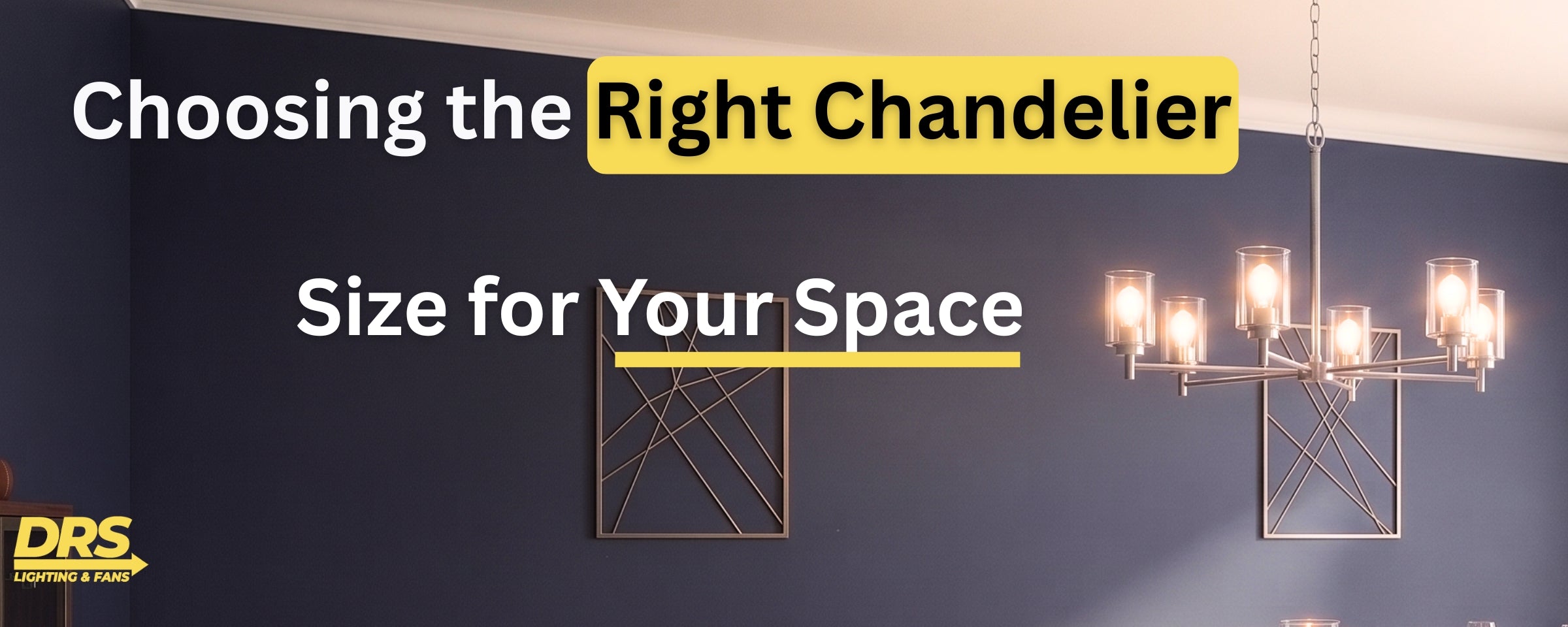
How to Choose the Right Chandelier Size for Your Space
A chandelier can instantly transform a room, but choosing the wrong size can make the space feel unbalanced. A chandelier that is too small may get lost in the room, while one that is too large can overwhelm the furniture and ceiling height.
The right chandelier should complement the room’s dimensions, provide comfortable lighting, and create a natural focal point. This guide explains how to choose the correct chandelier size for dining rooms, living rooms, bedrooms, entryways, and other areas of your home.

Why Chandelier Size Matters
Chandeliers are both functional light fixtures and decorative design elements. Their size affects how the entire room feels.
A properly sized chandelier can:
- Create a balanced focal point
- Improve the room’s overall proportions
- Provide better light coverage
- Complement nearby furniture
- Make the ceiling feel appropriately filled
Before selecting a chandelier based only on style, measure the room, ceiling height, and furniture beneath the fixture.
How to Calculate Chandelier Size for a Room

A simple formula can help you estimate the correct chandelier diameter.
Chandelier Diameter Formula
Add the room’s length and width in feet. Use the combined number as the recommended chandelier diameter in inches.
Room length + room width = chandelier diameter
For example:
A room that measures 12 feet by 14 feet would work well with a chandelier approximately 26 inches in diameter.
12 + 14 = 26 inches
This formula provides a helpful starting point for chandeliers placed in the center of living rooms, bedrooms, entryways, and other open spaces.
Chandelier Size Chart by Room Dimensions
| Room Size | Recommended Chandelier Diameter |
|---|---|
| 8 feet by 10 feet | 17–20 inches |
| 10 feet by 10 feet | 20–22 inches |
| 10 feet by 12 feet | 22–24 inches |
| 12 feet by 12 feet | 24–26 inches |
| 12 feet by 14 feet | 26–28 inches |
| 14 feet by 16 feet | 30–34 inches |
| 16 feet by 18 feet | 34–38 inches |
| 18 feet by 20 feet | 38–42 inches |
These measurements are general recommendations. The chandelier’s shape, visual weight, and placement should also be considered.
How to Choose a Chandelier for a Dining Table
When installing a chandelier above a dining table, the table’s dimensions are usually more important than the overall room size.
The chandelier should generally measure between one-half and two-thirds of the table’s width.
For example, if your dining table is 42 inches wide, look for a chandelier approximately 21 to 28 inches wide.
The fixture should also be narrower than the table so guests do not bump into it when standing or sitting.
Five-light fixtures land in this range for most standard dining tables. In our catalog, the Laredo 5-Light Chandelier with white glass gives you softer, diffused light over the table, while the Mincio 5-Light Clear Glass Chandelier keeps the bulbs visible for a brighter, more open look. Both come in matte black or brushed nickel to match your existing hardware.
Recommended Hanging Height Above a Dining Table
The bottom of the chandelier should usually hang approximately 30 to 36 inches above the tabletop when installed under an 8-foot ceiling.
For ceilings higher than 8 feet, you can raise the chandelier by approximately 3 inches for every additional foot of ceiling height.
For example:
- 8-foot ceiling: 30–36 inches above the table
- 9-foot ceiling: 33–39 inches above the table
- 10-foot ceiling: 36–42 inches above the table
The fixture should feel connected to the table without blocking the view across the room.

Choosing a Chandelier for a Kitchen Island
A chandelier or linear fixture above a kitchen island should be proportional to the island’s length and width.
For a single fixture, choose a chandelier that is approximately one-half to two-thirds of the island’s width.
For two or more fixtures, leave enough space between them to create even lighting without making the area look crowded. The outside edges of the fixtures should generally remain at least 6 inches inside the ends of the island.
The bottom of the fixture should typically hang about 30 to 36 inches above the countertop.
Compact fixtures work especially well in pairs over longer islands. Our Sputnik 6-Light 14" Chandelier is sized for exactly this: two of them spaced along an island give even coverage without crowding the sightline to the range or sink. If you prefer a single integrated-LED fixture, the Amalfi LED Hex Chandelier delivers 45W at 4000K through frosted glass, a practical color temperature for food prep.
Choosing a Chandelier for a Living Room
In a living room, use the room-size formula to estimate the correct chandelier diameter. Add the room’s length and width in feet, then convert the total to inches.
A 14-foot by 16-foot living room, for example, may need a chandelier approximately 30 inches wide.
Also consider the size of the furniture arrangement. A chandelier centered above a large seating area should feel proportional to the sofa, coffee table, and surrounding furniture.
Large rooms may require:
- A wider chandelier
- A multi-tier chandelier
- Multiple coordinated fixtures
- Additional recessed or accent lighting
A chandelier should support the room’s lighting plan rather than serve as the only light source.
For mid-size living rooms, the 24-inch Zara 6-Light Chandelier in matte black holds its own as a focal point without dominating the ceiling. Larger rooms that need more spread can step up to the Alph 10-Light Flat Bottom Chandelier, a candle-style fixture available in matte black, matte gold, or brushed nickel, or the Laredo 9-Light Chandelier with white glass when the seating area calls for wider, softer coverage.

Choosing a Chandelier for a Bedroom
Bedroom chandeliers can be placed in the center of the room, above the bed, or near a sitting area.
For a centrally placed chandelier, use the room’s length and width to estimate the diameter. For a chandelier installed above the bed, choose a fixture that is visually proportional to the bed frame without extending too far beyond it.
Avoid hanging the chandelier too low in areas where people regularly walk. In most bedrooms, the bottom of the fixture should remain at least 7 feet above the floor.
Choosing a Chandelier for an Entryway
Entryway chandeliers often create the first major focal point guests see when entering a home.
For a standard entryway, use the room-size formula to calculate the chandelier’s approximate diameter. For a two-story foyer, you may need a larger or taller fixture to fill the vertical space.
In a two-story entryway, the chandelier should generally be positioned where it can be seen from both levels. Many homeowners center the fixture near the upper portion of the first-floor windows or between the two floors.
The exact height will depend on the staircase, windows, ceiling structure, and overall fixture design.
Sputnik-style fixtures suit two-story foyers because they look good from every angle, including from the staircase above. The 18-Light Odyssey Chandelier in matte black and brushed brass fills vertical space with its sphere silhouette while the open frame keeps light passing through to both levels.
How Ceiling Height Affects Chandelier Size
Ceiling height affects both the chandelier’s hanging height and its vertical size.
A common guideline is to allow approximately 2.5 to 3 inches of chandelier height for every foot of ceiling height.
For example:
- 8-foot ceiling: chandelier approximately 20–24 inches tall
- 9-foot ceiling: chandelier approximately 22–27 inches tall
- 10-foot ceiling: chandelier approximately 25–30 inches tall
- 12-foot ceiling: chandelier approximately 30–36 inches tall
This is only a starting point. Open foyers, vaulted ceilings, and staircases can accommodate taller fixtures than standard rooms.
How High Should a Chandelier Hang?

The correct hanging height depends on where the chandelier is installed.
Above an Open Floor
The bottom of the chandelier should generally remain at least 7 feet above the floor.
Above a Dining Table
Leave approximately 30 to 36 inches between the tabletop and the bottom of the chandelier.
Above a Kitchen Island
Leave approximately 30 to 36 inches between the countertop and the bottom of the fixture.
In a Two-Story Foyer
Position the chandelier so it is visually centered within the open vertical space and visible from both floors.
Always check that doors, cabinets, and walkways have enough clearance.
Consider the Chandelier’s Visual Weight
Two chandeliers with the same diameter can look completely different in a room.
A chandelier with thick arms, dark finishes, large shades, or multiple tiers may appear heavier than an open-frame fixture of the same size. Because of this, visually heavy chandeliers may need to be slightly smaller, while minimalist designs can often be slightly larger without overwhelming the space.
Consider these design features:
- Number of lights
- Number of tiers
- Width and thickness of the frame
- Glass or crystal details
- Shade size
- Finish color
- Open or enclosed construction
The goal is to create balance rather than follow a measurement formula exactly.
You can see this in our own catalog: the open-frame 18-Light Odyssey carries eighteen bulbs yet reads lighter in a room than the nine-shade Laredo 9-Light, because bare bulbs on thin arms occupy far less visual space than a ring of white glass shades.
Common Chandelier Sizing Mistakes

Choosing a Fixture That Is Too Small
A small chandelier can disappear in a large room. When deciding between two sizes, the slightly larger option often creates a stronger and more intentional focal point.
Ignoring the Furniture Below
A chandelier may fit the room but still look incorrect above a narrow dining table or small kitchen island. Always compare the fixture dimensions with the furniture beneath it.
Hanging the Chandelier Too High
A chandelier positioned too far above a table can feel disconnected from the furniture and provide less focused lighting.
Hanging the Chandelier Too Low
Low fixtures can block sightlines, interfere with movement, and make the room feel crowded.
Using Only One Light Source
A chandelier may not provide enough light for the entire room. Combine it with recessed lighting, wall sconces, lamps, or undercabinet lighting when necessary.
Frequently Asked Questions
Should a chandelier be wider than the dining table?
No. A dining room chandelier should generally be narrower than the table. A fixture measuring approximately one-half to two-thirds of the table’s width usually provides a balanced appearance.
Is it better for a chandelier to be too big or too small?
A slightly oversized chandelier often looks more intentional than one that is noticeably too small. However, the fixture should not interfere with walkways, doors, cabinets, or sightlines.
How do I measure for a round chandelier?
Use the chandelier’s widest point as its diameter. Compare that measurement with the room dimensions or the width of the furniture beneath it.
Can I install a chandelier on an 8-foot ceiling?
Yes. Choose a fixture with a shorter body or a semi-flush design, especially when the chandelier is installed above an open walking area. A hanging chandelier can also work above a dining table because the table prevents people from walking underneath it. Our chandelier collection includes ceiling mounts alongside hanging fixtures, so you can filter by product type when working with lower ceilings.
What size chandelier works over a 60-inch dining table?
A chandelier approximately 30 to 40 inches wide may work well over a 60-inch-wide table, depending on the table’s shape and the chandelier’s visual weight.
Final Chandelier Sizing Checklist

Before purchasing a chandelier, confirm the following:
- Measure the room’s length and width.
- Measure the ceiling height.
- Measure the table or island beneath the fixture.
- Check the chandelier’s diameter and height.
- Confirm the hanging height and walkway clearance.
- Consider the fixture’s visual weight.
- Determine whether additional lighting will be needed.
- Verify that the electrical box can support the fixture’s weight.
Find the Right Chandelier for Your Space
Choosing the correct chandelier size does not have to be complicated. Start with the room dimensions, compare the fixture with the furniture below it, and adjust for ceiling height and visual weight.
The right chandelier should feel noticeable without overpowering the space. With accurate measurements and proper placement, your new fixture can provide both attractive lighting and a well-balanced focal point.
Explore our full selection of chandeliers, island lights, and open cage fixtures at Direct Renovation Supply to find a fixture that fits your room, style, and renovation needs. Full-price items ship free, and our closeout inventory changes regularly, so check back if the size or finish you need is not in stock today.