
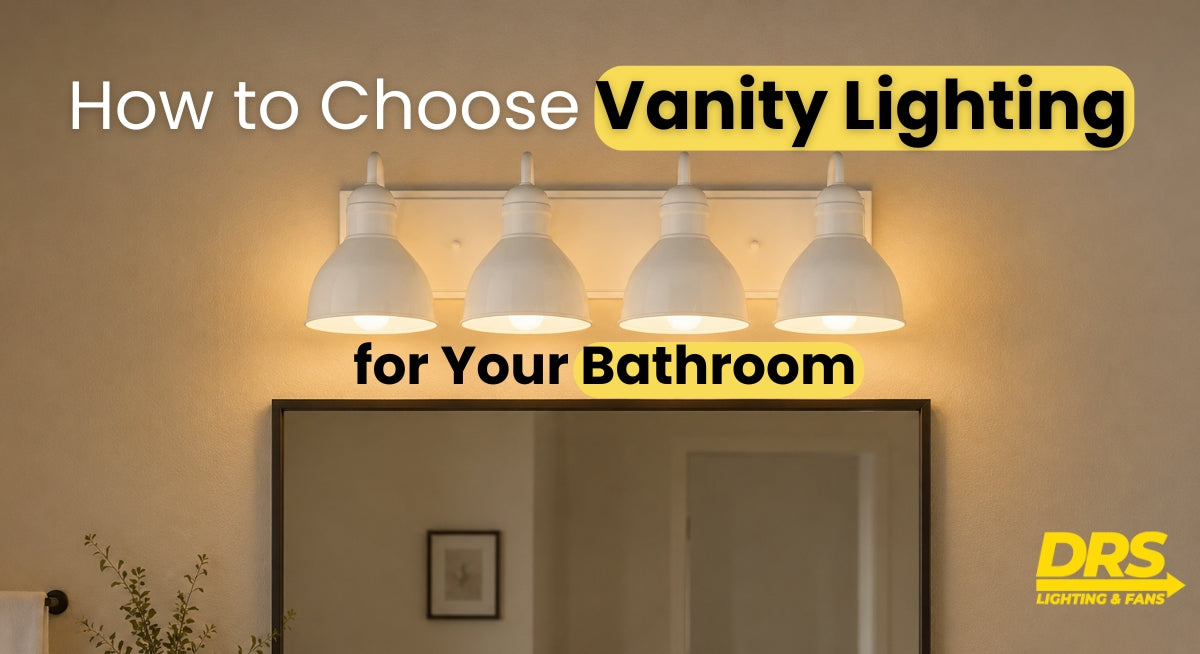
How to Choose Vanity Lighting for Your Bathroom
Bathroom vanity lighting plays an important role in both the appearance and functionality of your space. The right fixture can make everyday tasks like shaving, applying makeup, and getting ready much easier while also improving the overall design of your bathroom.
With so many fixture sizes, styles, finishes, and light temperatures available, choosing the best bathroom vanity lighting can feel overwhelming. This guide explains how to choose vanity lighting for your bathroom based on vanity size, placement, brightness, color temperature, and style.
Why Bathroom Vanity Lighting Matters
A bathroom may have overhead lighting, but a ceiling fixture alone can create shadows across your face. Vanity lighting provides focused illumination around the mirror, helping you see more clearly while completing your daily routine.
Well-chosen vanity lights can also:
-
Reduce shadows around the face
-
Improve visibility near the mirror
-
Make the bathroom feel brighter and more inviting
-
Complement faucets, mirrors, and cabinet hardware
-
Create a polished and coordinated bathroom design
The goal is to combine practical lighting with a fixture that fits the size and style of the room.
Start With the Size of Your Vanity

For example, a 36-inch vanity may work well with a vanity light measuring approximately 24 to 30 inches wide. In our collection, the Vivio Gia 3-Light Vanity at 24 inches and the Aura 3-Bulb Two-Toned Vanity at 27 inches both fall within that range.
Larger double-sink vanities may require one long fixture centered above the mirror or two smaller fixtures positioned over each sink. Separate fixtures can provide more balanced lighting across a wide vanity, especially when each sink has its own mirror. If you prefer a single fixture, a wider bar such as our 48-inch 6-Light Bathroom Vanity Light in brushed nickel can cover the full span of a double vanity.
Before purchasing a fixture, measure:
-
The width of the vanity
-
The width and height of the mirror
-
The distance between the mirror and ceiling
-
The available wall space beside the mirror
Taking accurate measurements helps prevent the fixture from looking too small, too large, or crowded.
Choose the Right Vanity Light Placement

Bathroom vanity lights are commonly installed either above the mirror or on both sides of it.
Above-the-Mirror Lighting
Installing a vanity light above the mirror is one of the most popular options because it works well in bathrooms with limited wall space.
The fixture should be centered with the mirror and vanity rather than centered on the entire wall. It should sit high enough to illuminate the face without creating excessive glare.
This placement works especially well with multi-light vanity bars that spread light evenly across the mirror.
This placement works especially well with multi-light vanity bars that spread light evenly across the mirror. The 37-inch Aura 4-Bulb Two-Toned Vanity is a good example, with four evenly spaced candle-base lamps along a single bar.
Side-Mounted Vanity Lights
Wall sconces installed on both sides of the mirror often provide the most balanced facial lighting. Because the light reaches the face from both directions, side-mounted fixtures can reduce the shadows sometimes created by overhead lighting.
Dual-purpose fixtures like the Maroni 3-Light Wall Sconce/Vanity in matte black and brushed nickel are designed to work in either role, which makes them a practical choice for flanking a mirror.
Combining Both Placements
In larger bathrooms, you may combine an overhead vanity fixture with wall sconces. This creates layered lighting and can provide better visibility throughout the room.
However, the fixtures should coordinate in finish, shape, or design so the vanity area does not look overcrowded.
Select the Right Number of Lights
Vanity fixtures are commonly available with one, two, three, four, or more lights.
A small powder room may only need a single sconce or two-light fixture. A standard bathroom vanity may benefit from a three-light fixture, while a wide double vanity may require four or more lights.
The number of bulbs does not always determine how bright the fixture will be. Bulb output, fixture design, shade material, and the direction of the light also affect brightness.
Instead of choosing a fixture based only on the number of lights, consider how evenly it will illuminate the entire vanity.
Pay Attention to Brightness
Bathroom vanity lighting should be bright enough for grooming without feeling harsh or uncomfortable.
Lumens measure the amount of visible light produced by a bulb. A higher lumen rating means a brighter light. Larger bathrooms and darker finishes may require more lumens than small bathrooms with white walls and reflective surfaces.
Dimmable vanity lighting can be especially useful. Bright light can help during morning routines, while softer lighting can create a more relaxing atmosphere in the evening.
When purchasing a dimmable fixture, confirm that the bulbs, fixture, and dimmer switch are compatible.
Choose the Best Color Temperature

Color temperature describes whether a light appears warm, neutral, or cool. It is measured in Kelvin, or K.
Warm White: 2700K to 3000K
Warm white lighting creates a soft, comfortable glow. It works well in traditional, farmhouse, and spa-inspired bathrooms.
However, very warm light may slightly change the appearance of makeup, clothing, or skin tones.
Neutral White: 3500K to 4000K
Neutral white provides a clean and balanced appearance. It offers good visibility without feeling overly blue or clinical.
For many bathrooms, a color temperature between 3000K and 4000K provides a comfortable balance between atmosphere and functionality.
Cool White: 5000K
Cool white lighting creates a bright, daylight-like appearance. It may be useful for detailed grooming tasks, but it can feel harsh in small bathrooms or relaxing spaces.
Consider the other lights in the bathroom when choosing a color temperature. Using similar color temperatures throughout the room creates a more consistent and professional appearance.
If you are unsure which temperature suits your space, selectable fixtures let you decide at installation. The Zenon 32" LED Strip Vanity switches between 3000K, 4000K, and 5000K, and most LED vanity lights in our collection include the same three settings.
Look for Accurate Color Rendering

The Color Rendering Index, commonly called CRI, measures how accurately a light source displays colors.
A higher CRI can make skin tones, makeup, towels, paint colors, and finishes appear more natural. For bathroom vanity lighting, look for LED fixtures or bulbs with a CRI of at least 80. A CRI of 90 or higher is ideal for areas where accurate color visibility is important.
Good color rendering is especially helpful when applying makeup or coordinating clothing.
Choose a Fixture Rated for Bathroom Use

Bathrooms contain moisture and humidity, so it is important to choose fixtures that are suitable for the installation area.
A damp-rated fixture is designed for locations exposed to moisture or humidity but not direct water. Many bathroom vanity fixtures are damp-rated.
Fixtures installed very close to a shower, bathtub, or other area where direct water exposure is possible may require a wet-location rating. Always check the fixture specifications and follow local electrical requirements.
A licensed electrician can help determine whether a particular fixture is appropriate for your bathroom.
Match the Fixture to Your Bathroom Style

Vanity lighting should complement the bathroom rather than compete with the other design elements.
Modern Bathrooms
Choose fixtures with clean lines, simple shapes, and finishes such as matte black, polished chrome, or brushed nickel. The Yarra 3-Light Vanity pairs a matte black frame with clear cylinder glass for an architectural look.
Traditional Bathrooms.
Look for curved arms, decorative details, glass shades, and finishes such as bronze, brass, or polished nickel. The Houston Decorative 4-Light Vanity fits this style, with alabaster glass shades on a brushed nickel frame.
Farmhouse Bathrooms
Fixtures with black metal, clear glass, seeded glass, or vintage-inspired bulbs can support a comfortable farmhouse appearance. The Vivio Gia 3-Light Vanity brings the barn-light shade and gooseneck arm that define the style, available in glossy black, white, or red.
Luxury Bathrooms
Consider polished finishes, decorative glass, crystal details, or sculptural fixtures that create a statement above the vanity. The Siene 2-Light Vanity makes that kind of impression, combining matte black with champagne gold accents and clear cone glass.
Your vanity light does not have to match every metal finish exactly. However, repeating the fixture's finish elsewhere in the room can help create a coordinated design.
Consider the Direction of the Light

Some vanity fixtures direct light upward, while others direct it downward. Certain models can be installed in either direction.
Upward-facing lights create softer ambient illumination by reflecting light off the wall and ceiling. Downward-facing lights provide more direct illumination around the mirror.
If the fixture is your primary source of task lighting, downward-facing shades may provide better visibility. If the bathroom already has strong overhead lighting, upward-facing fixtures may create a softer atmosphere.
Clear glass shades generally produce brighter, more direct light. Frosted or opal glass shades diffuse the light and can help reduce glare. You can see the difference across our range: clear glass fixtures like the Rhine 3-Light Vanity deliver direct light, while white glass options like the Victoria 3-Light Vanity soften it.
Coordinate the Vanity Light With the Mirror

The mirror and vanity light should look visually balanced.
A wide mirror usually works best with a wider fixture or multiple sconces. A small round mirror may pair well with two slim wall sconces or a compact fixture above it.
Make sure there is enough space between the mirror and fixture. A large light installed too close to the mirror can make the vanity area feel crowded, while a very small fixture may look out of proportion.
When using a medicine cabinet, check how far it projects from the wall. The fixture may need to extend far enough to prevent the cabinet from blocking the light.
Avoid These Common Vanity Lighting Mistakes

One common mistake is choosing a fixture that is too small for the vanity. A narrow light above a large double vanity may leave the outer areas poorly illuminated.
Another mistake is relying only on a ceiling fixture. Overhead lighting can create shadows beneath the eyes, nose, and chin.
Other issues include mixing noticeably different color temperatures, selecting bulbs that are too dim, installing the fixture off-center, and choosing a fixture that is not rated for bathroom conditions.
Measuring the space and reviewing the product specifications before installation can help prevent these problems.
Final Vanity Lighting Checklist
Before selecting your bathroom vanity lighting, confirm that the fixture:
-
Fits the width of the mirror and vanity
-
Provides even illumination across the face
-
Has the appropriate brightness and color temperature
-
Uses bulbs with good color rendering
-
Is rated for the bathroom environment
-
Coordinates with the bathroom’s finishes and style
-
Fits comfortably between the mirror and ceiling
Find the Right Bathroom Vanity Lighting
The best bathroom vanity lighting combines proper sizing, balanced placement, comfortable brightness, and a style that complements the rest of the room. Begin by measuring your vanity and mirror, then consider how the fixture will illuminate the space during everyday tasks.
Direct Renovation Supply offers bathroom vanity lighting in a variety of sizes, finishes, and designs. Explore our lighting selection to find a fixture that brings better visibility, functionality, and style to your bathroom.
Frequently Asked Questions
Should vanity lights be wider than the mirror?
In most bathrooms, the vanity light should be narrower than the mirror and should not extend beyond the width of the vanity. A fixture measuring approximately 75% of the mirror’s width often creates a balanced appearance.
Should bathroom vanity lights face up or down?
Downward-facing lights provide more direct task lighting, while upward-facing lights create softer ambient illumination. The best direction depends on the fixture design and the other lighting available in the bathroom.
What color temperature is best for bathroom vanity lighting?
A color temperature between 3000K and 4000K works well in many bathrooms. It provides a clean, comfortable light that is suitable for grooming without appearing excessively warm or cool.
Are LED lights good for bathroom vanities?
Yes. LED vanity lights are energy-efficient, long-lasting, and available in several brightness levels and color temperatures. Look for LEDs with a high CRI for more accurate color visibility.
Do bathroom vanity lights need to be damp-rated?
Bathroom fixtures should generally be rated for damp locations because bathrooms regularly experience moisture and humidity. Fixtures exposed to direct water may require a wet-location rating.